Skip to content
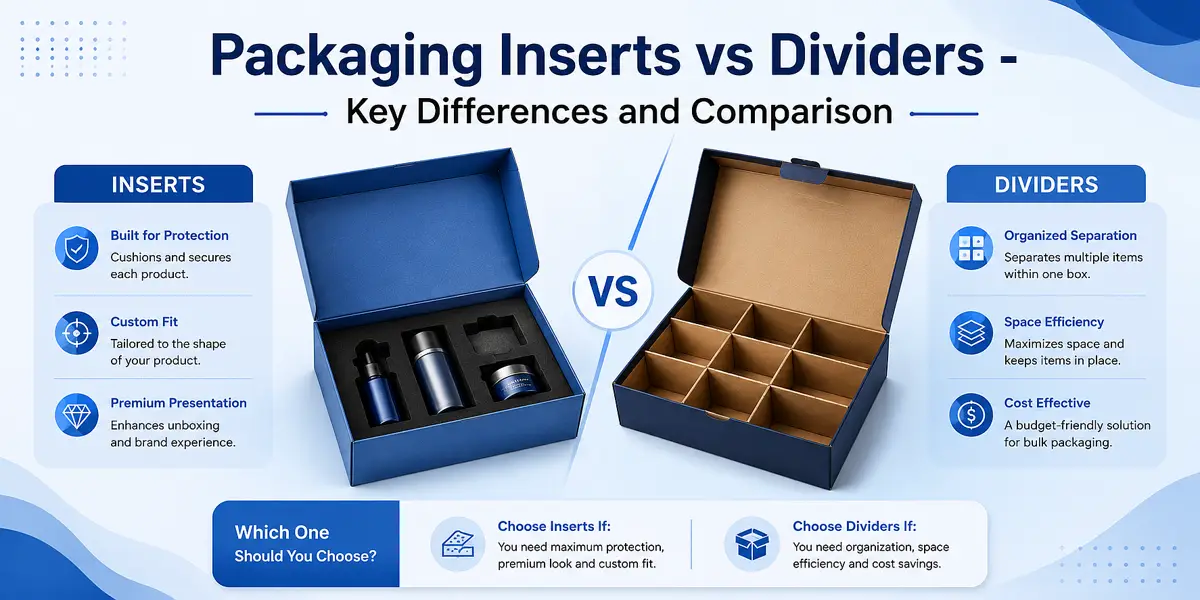
If you are reading this, you are more likely looking for a packaging solution that not only delivers but also protects your product. In such cases, you can use packaging inserts and dividers to deliver your product to your customer safely.
That’s where a question arises: Are packaging inserts and dividers different in nature?
As a packaging expert and consultant at Instant Custom Boxes, I came up with this guide on packaging inserts vs dividers to help you understand the difference. After reading this guide, you’ll be able to make data-driven decisions about what packaging solution to choose.
What are Packaging Inserts?
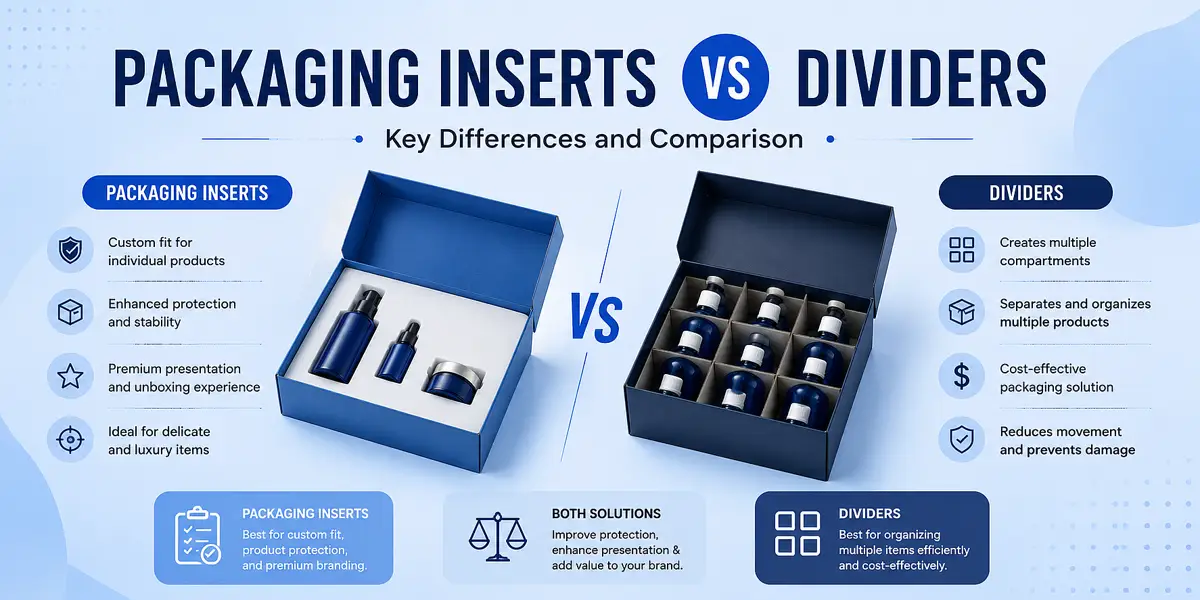
Packaging inserts are interior materials, like foam, cardboard, and molded pulp, that are placed in a box to hold, support, and protect the products during delivery.
These inserts keep holding your products in place while protecting them from bending and crushing during transit. Such a packaging solution gives your product a premium and luxurious feel while leaving an exceptional unboxing impression on your customers.
Main Types of Packaging Inserts
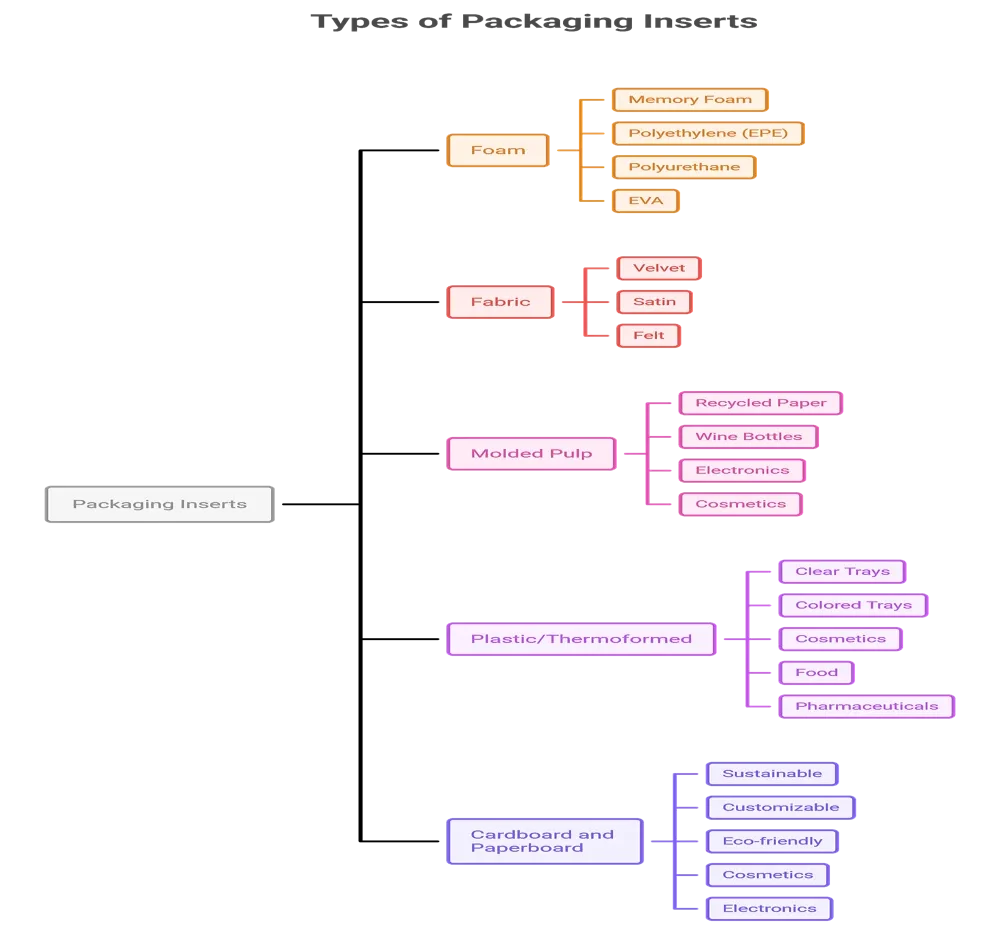
There are five main types of packaging inserts, and we use them all to help you choose what you like:
- Foam: Ideal for maximum protection and delicate items (electronics, cosmetics). Types include Memory Foam, Polyethylene (EPE), Polyurethane, and EVA with a snug fit.
- Fabric: High-end options (velvet, satin, felt) are used to add luxury, texture, and protection for luxury goods, jewelry, and watches.
- Molded Pulp: Eco-friendly option made from recycled paper, offering strong protection for wine bottles, electronics, and cosmetics. Often, a superior sustainable alternative to plastic.
- Plastic/Thermoformed: Clear or colored trays that offer a sleek, professional presentation for cosmetics, food, and pharmaceuticals.
- Cardboard and Paperboard: Sustainable, customizable, and eco-friendly options for organizing products like cosmetics or electronics.
What are Packaging Dividers?
Packaging dividers are also interior materials, corrugated cardboard or paperboard, that are placed in a box to hold your products in one place while protecting them from damage during transit.
This packaging solution is used to hold and separate your fragile products, like glass and electronics, to prevent damage during delivery. Such a packaging solution enhances your products’ appeal and leaves a long-lasting unboxing impression on your customers.
Main Types of Box Dividers

There are six main types of box dividers that add appeal to your custom boxing:
- Folding: Made from a single piece of paperboard or corrugated material, these are scored and folded to create multiple compartments, often used for smaller, lighter products.
- Hybrid: Hybrid dividers include bin boxes (for small, organized storage), folding dividers with tails (for stability), and plastic (Correx) inserts for liquid-resistant or reusable applications.
- Interlocking: These consist of notched strips of corrugated or chipboard that fit together, which forms a sturdy grid structure. They are ideal for separating bottles, glassware, or small parts into individual cells.
- Die-cut Custom: Precisely cut to match the unique shape of a product while providing a snug, high-end fit. They are often used in luxury or fragile item packaging.
- Corrugated Partition: Durable, fluted cardboard dividers that provide excellent stacking strength and cushioning for heavier items.
- Chipboard Partition: Thin, dense, and lightweight dividers perfect for separating smaller items while maximizing internal box space.
Key Differences Between Packaging Inserts and Dividers
Now, you are completely aware of what inserts and dividers are. It’s time to understand what characteristics make them different:
| Feature | Packaging Inserts | Packaging Dividers |
| Materials | Foam, molded pulp, cardboard, corrugated board | Corrugated cardboard, chipboard, plastic |
| Cost | Higher (especially custom or foam-based) | Lower (simple design, bulk-friendly) |
| Sustainability | Varies (eco if paper-based, poor if plastic foam) | Generally eco-friendly (recyclable cardboard) |
| Use Cases | Fragile, high-value, delicate items (electronics, glass) | Multiple items needing separation (bottles, sets) |
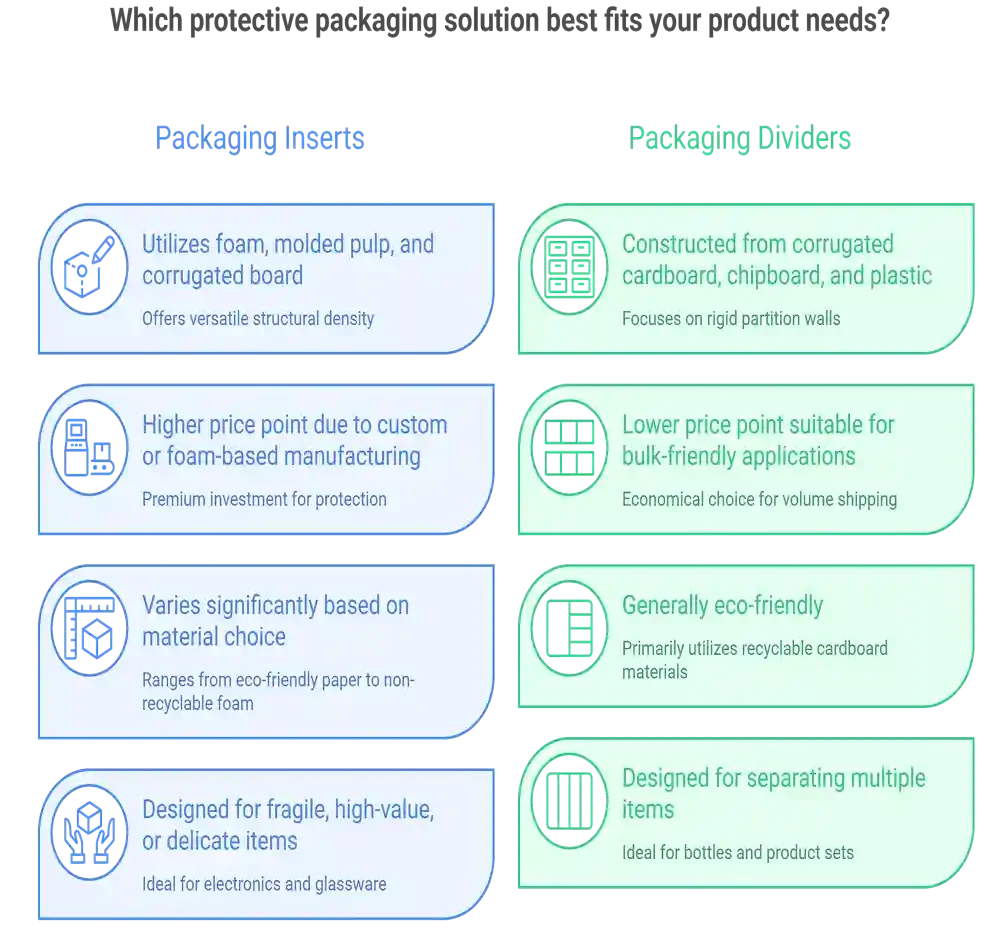
1. Materials Comparison
Packaging inserts are typically made from softer, more flexible materials such as foam, molded pulp, cardboard, or corrugated paperboard. These materials are chosen to cushion and protect products from impact during transit to absorb shock effectively.
On the other hand, dividers are usually made from sturdier and more rigid materials like corrugated cardboard, chipboard, or plastic. Their purpose is not so much cushioning as it is separation and organization while creating compartments to prevent items from colliding.
2. Cost Comparison
Inserts are generally more expensive than dividers, especially when they are custom-designed. Foam inserts or molded pulp solutions often require specialized manufacturing processes or tooling, which increases cost.
Dividers are typically more cost-effective. They are simpler in design and easier to produce in bulk, especially when made from standard corrugated materials. However, the marketing price range for these items is $0.5 to $2.08.
3. Sustainability Angle
Sustainability depends heavily on the material used, but generally, paper-based inserts (like molded pulp or cardboard) are recyclable and eco-friendly. However, foam inserts, particularly those made from non-biodegradable plastics, are less sustainable and harder to recycle.
Dividers often have a stronger sustainability profile because they are commonly made from corrugated cardboard. As you know, corrugated material is widely recyclable and sometimes even made from recycled content. They also tend to use less material overall compared to bulky inserts while reducing waste and carbon footprint.
4. Use Cases / When to Use Each
Packaging inserts are best used when product protection is your top priority throughout the procedure. They are ideal for fragile, delicate, or high-value items such as electronics, glassware, cosmetics, or medical equipment.
Dividers are more suitable when you need to organize multiple items within a single package. They are commonly used for products like bottles, jars, or sets of items that need to be kept separate but not necessarily cushioned individually.
Dividers are especially useful in bulk shipping or retail packaging where structure and separation matter more than impact resistance. On the other hand, inserts are used to hold items snugly in place, minimize movement, and absorb shocks during shipping.
Benefits of Using Packaging Inserts or Dividers
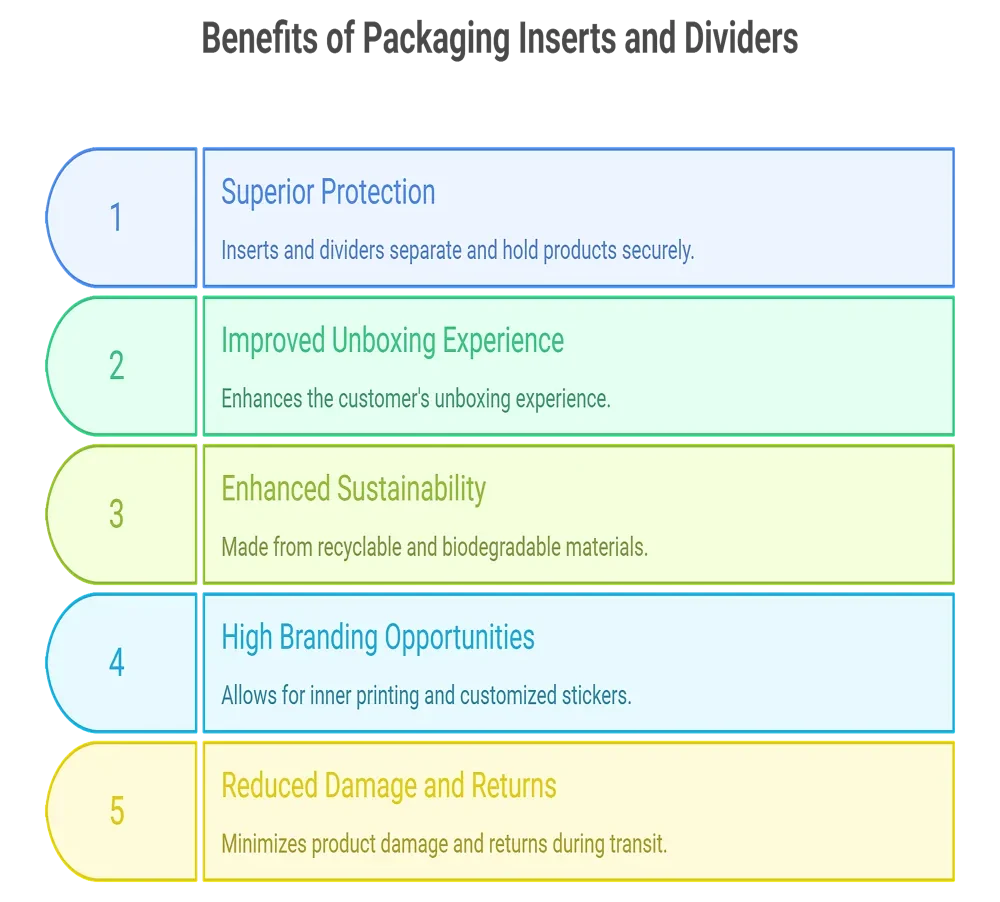
No matter if the inserts and dividers are somehow different from each other, but they provide some mutual benefits for packaging. Here are some benefits of using them:
1. Superior Protection
Packaging dividers and inserts offer superior protection for your products because they separate them and hold them up, respectively. If your purpose is to separate your products into a single box, choose dividers. If you want to fit multiple products while holding them in place, go for inserts.
Note: Instant Custom Boxes allows you to choose both for your custom packaging design to give your products a double layer of protection.
2. Improved Unboxing Experience
Usually, customers only presume their product is in the box in normal condition without expecting businesses’ efforts. When you include these items in your box, they not only improve the product protection but also enhance the unboxing experience to convert your customers into regular buyers.
3. Enhanced Sustainability
No matter if you choose inserts or dividers, they are both engineered from 100% recyclable and biodegradable cardboard or Kraft material. This approach ensures that these dividers and inserts can reduce the carbon footprint.
4. High Branding Opportunities
By choosing inner printing for your boxes, you can strengthen your brand identity while giving your inserts or dividers the same brand color and theme. You can also choose to put a customized sticker to greet your customers and convert them into loyal buyers.
5. Reduced Damage and Returns
As these items protect your products during transit, the chances of getting a product return of damage is minimized up to 25%. If your products are highly fragile, you should go for dividers, and if they are less fragile, you can go with inserts.
How to Choose Between Inserts vs Dividers
Here are some basic steps that you can perform to choose between inserts and dividers:
1. Understand Your Packaging Need
First of all, you need to understand your packaging requirements, whether they’re premium, luxurious, or just security concerns. When your packaging needs are more intended for security and luxury, you can go for inserts and dividers.
As a consultant, I always recommend clients to ask themselves some questions, like:
- Do I need inserts and dividers?
- Why do I need inserts and dividers?
- What if I choose inserts or dividers for my product?
2. Define Your Products’ Fragility
After understanding your packaging requirements, it’s time to define your products’ fragility to focus on what packaging can deliver your products safely. The use of inserts and dividers is mainly based on the product’s fragility.
If your products are highly fragile, like glass materials, electronics, and wax, you should go for dividers. If your products are steel-made and iron customized, the way of choosing inserts is also open.
3. Choose from Inserts and Dividers
At last, you have come to know more about your products and packaging requirements. Now, use this information to make a data-driven decision about choosing between inserts vs dividers.
Looking for a Reliable Packaging Partner?
If you’re looking for a reliable packaging partner, then Instant Custom Boxes would be your destination.
You can completely customize your packaging design, size, colors, and finishes to make your dream packaging a reality with us. Collaborate with our professional design team to personalize your packaging without a setup fee.
Get a quote and have your order delivered at your doorstep in 8-10 business days!
Before You Go
Both custom boxes with inserts and dividers are for protection, but their way of providing security is different, as inserts support products and dividers separate them. You can choose the one that suits you the best for delivering and showcasing your products to customers.
In the above section, I’ve elaborated all about inserts and dividers, including their types, use cases, and price ranges. You can use this data to make informed decisions to showcase your products to a wide range of customers.
People Also Ask
Q1. What’s the main difference between inserts and dividers?
The main difference between inserts and dividers is that inserts hold a product inside a box, and dividers separate multiple products in a single box.
Q2. Do inserts provide better protection than dividers?
Yes, of course. Inserts provide better protection than dividers because of the materials used, like foam and mold pulp.
Q3. Are inserts and dividers eco-friendly?
Of course, we engineer inserts and dividers with corrugated and Kraft materials that are 100% biodegradable and eco-friendly.
Q4. Can I use both inserts and dividers in one packaging?
Yes, you can use both inserts and dividers in one packaging for ultimate protection while leaving a long-lasting impression on your customers.